
Recent fires are testing more than our fire service
By 28 July, fire and rescue services in England and Wales had responded to 706 wildfires in 2026. More than 200 of those incidents were recorded in less than two weeks, during another spell of prolonged hot and dry weather.
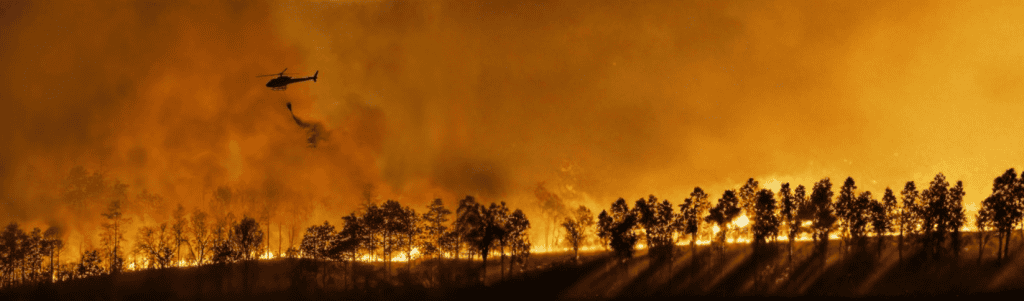
In North Wales, a wildfire in the Rhinogydd burned across remote, protected habitats and required helicopter support. Drought was later declared across North Wales and the Upper Severn after a prolonged spell of hot, dry weather had put further pressure on the region. At the time of publication, significant fires are still affecting parts of the country. In the New Forest National Park, one has forced the closure of a main A road between Southampton and Bournemouth, with repairs needed before the route can reopen.
For Hazards Forum, our concern goes beyond the number of incidents. Wildfires can put pressure on a number of services, including power, water and communications at the same time as those systems may be needed to support the response. They can threaten industrial sites and create knock-on hazards long after a fire itself has been brought under control. These were among the consequences raised when we brought together specialists to discuss the issue in 2024.
Our roundtable, Preparing the UK for Wildfires of the Future, gathered people working across wildfire response, research, regulation and infrastructure to consider how the UK understands and manages wildfire risk.
Two years on, the question we perhaps should be asking ourselves is whether our approach is keeping pace.
Understanding the risk before the fire starts
Professor Guillermo Rein of Imperial College London argued at the roundtable that the UK needs a more rigorous, science-based way of characterising wildfire risk. This means knowing where fires are more likely, where the consequences could be greatest and what protection already exists.
His work since the event makes the case for looking beyond individual incidents. Research into the 2022 London wildfires identified what his team describes as ‘firewaves’: cascading wildfires driven by the same heatwave, with the potential to overwhelm fire and rescue resources.
In managing the risks of wildfires, we need to be considering what happens if several fires occur across the region at once. And, what if these same conditions are also putting pressure on water supplies, power networks or staff availability?
Rein’s team has also tested leading wildfire spread models, including models from the US and Canada, and an AI model developed by Google. No single model performed consistently well. Combining predictions, however, produced a better probability map of how a wildfire might behave. For planners that supports embracing the uncertainty.
Our roundtable reached a similar conclusion from a risk-management perspective. Participants discussed using tools such as the Bowtie model to identify the barriers that prevent a wildfire starting, limit its spread or reduce its consequences, then make clear who is responsible for each one.
Water is a resilience issue too
Our discussion in 2024 also exposed a basic dependency, namely that firefighting requires water, and a major wildfire can arrive during the same hot, dry conditions already stretching water supplies.
Seamus Doyle of Mid and West Wales Fire and Rescue Service described work with Welsh Water to make UV-treated wastewater available for firefighting. His later update showed what turning an idea into an operational option involves. Firefighting teams have trained using bowsers and appliances at UV treatment sites, access has been tested, monitoring arrangements have been developed with the water company and work has continued on fitting hydrants to raw-water mains.
The 2024 roundtable considered how wildfire damage could interrupt critical infrastructure and, in some circumstances, trigger secondary chemical or industrial incidents. This would then require extra resources from the Fire and Rescue Service thereby further constraining the resources. It also raised the risk of flooding, erosion and landslip after vegetation has been destroyed.
Progress, but no room for complacency
There has been movement since our roundtable. In his 2025 update, Rob Stacey of the England and Wales Wildfire Forum pointed to new Level 1 wildfire training for operational fire and rescue personnel, work on a National Wildfire Training Framework and research into wildfire management planning.
There have also been changes at government level. In June 2026, specialist wildfire teams were announced for Lancashire, Greater Manchester, Northumberland, London and South Wales, alongside a wider £97 million upgrade of National Resilience assets. The teams are intended to deploy across England when large incidents put pressure on local services.
Fire and rescue services are, however, only one part of the answer. Wildfire risk also sits with those managing land, infrastructure, regulation and local resilience, alongside government and high-hazard industries. Our roundtable showed that there is no shortage of expertise across these areas, but it is how those responsibilities connect, and who takes ownership when they overlap. Education and awareness raising within society has a role to play considering that wildfires tend not to occur naturally.
Risk assessments need to consider what surrounds a site, how changing conditions affect exposure, which barriers would protect people and operations, and what external systems the response relies on.
Our 2024 roundtable called for high-hazard industries to give wildfire greater consideration within their existing risk arrangements. This summer, that call to action feels more relevant than ever. Professor Rein ended his follow-up with a simple judgement: the UK has the expertise but needs a coordinated effort to turn it into action. When the conditions worsen again, will the right barriers and resources already be in place?
